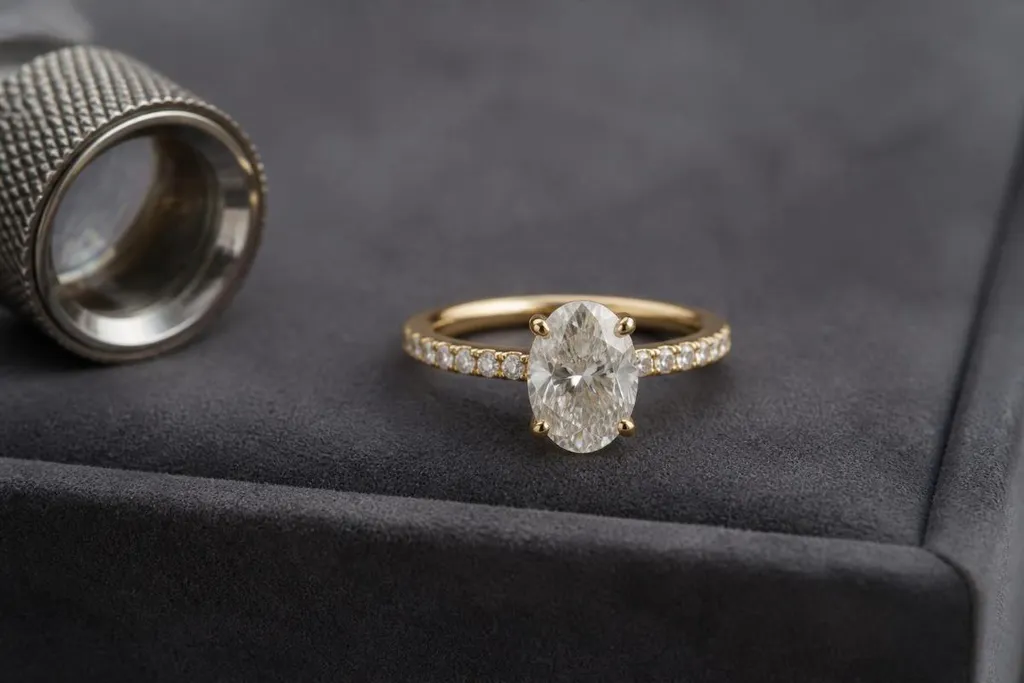
An oval centre diamond already brings length and presence to an engagement ring, but adding diamond-set shoulders changes how that presence is distributed across the hand. Instead of the eye stopping at a single centre stone, smaller diamonds guide it outward along the band. The challenge is balance: the shoulders should enhance the oval rather than compete with it. In 18k yellow gold, the contrast between bright lab-grown diamonds and warm metal makes this relationship particularly noticeable.
For someone considering this style, the option to order the yellow gold Viola ring from Lily Arkwright shows how an oval lab diamond and shoulder-set detailing can be brought together in a yellow gold setting. The design offers more continuous sparkle than a plain solitaire while preserving a clearly defined centre stone.
Why the Oval Should Remain the Focal Point
The strength of an oval engagement ring lies partly in its distinctive silhouette. Its elongated outline creates a graceful line along the finger, combining the softness of curved edges with greater length than a round brilliant.
Shoulder diamonds need to support that shape rather than visually flatten it into a continuous row of similarly prominent stones. A successful arrangement creates a hierarchy: the centre oval attracts attention first, followed by the smaller diamonds extending towards the band.
Centre-stone proportions influence this effect. A broader oval creates a fuller focal point, whereas a more elongated diamond gives the ring a slender appearance. Neither is inherently preferable; the right choice depends on hand proportions and personal taste.
A larger centre stone can also make sense for reasons beyond simple size. Someone choosing a 2-carat oval, for example, may want enough visual authority to keep the centre clearly dominant despite the additional sparkle across the shoulders.
How Shoulder-Set Diamonds Change the Ring
Diamond-set shoulders provide a different effect from a halo.
A halo increases brilliance immediately around the centre stone and changes its perceived outline. Shoulder setting leaves the oval's perimeter exposed, preserving the shape while adding sparkle horizontally across the finger.
This can be particularly appealing for someone who likes the clarity of a solitaire but wants more detail than a plain band provides. From above, the oval remains easy to distinguish, yet the ring feels more decorative as the smaller stones carry light towards either side.
The size and spacing of those diamonds matter. Fine stones can create a gradual transition from the centre setting into the band. Larger shoulder diamonds make a stronger statement but risk competing with the oval if their scale is not carefully controlled.
The best balance often feels effortless because no individual supporting element demands too much attention.
Why 18k Yellow Gold Adds Definition
Yellow gold introduces warmth and contrast into a diamond-rich design.
With white metal, small shoulder diamonds can visually merge with the setting, creating an almost uninterrupted line of brightness. In 18k yellow gold, glimpses of warm metal remain visible around the stones and along the lower band.
This helps define the construction of the ring and gives the diamonds a crisp appearance against their setting. It also creates an appealing meeting of traditional and contemporary influences: yellow gold has a long history in fine jewellery, while an elongated lab-grown diamond with shoulder-set detailing feels distinctly current.
The metal is particularly practical stylistically for someone who already wears yellow gold. A matching wedding band, earrings or bracelet can create continuity without requiring every piece to share the engagement ring's diamond detailing.
Regular cleaning helps maintain the contrast, as residue around smaller shoulder stones can reduce their apparent brightness.
Planning the Wedding Band and Everyday Wear
A shoulder-set engagement ring offers several wedding-band possibilities.
A plain 18k yellow gold band provides contrast and keeps the engagement ring as the primary source of sparkle. A diamond-set wedding band creates a brighter bridal stack and can visually continue the shoulder stones around more of the finger.
Proportion should guide the choice. If the engagement ring has fine shoulders, an exceptionally wide or heavily set wedding band may shift the visual balance away from the oval centre.
Setting profile matters too. Depending on the structure beneath the centre diamond, a straight wedding ring may sit closely alongside the engagement ring or leave a small intentional gap.
Care is especially important because shoulder-set designs contain multiple small settings in addition to the claws securing the oval. Periodic professional checks can help ensure these remain secure, while removing the ring during heavy manual activities reduces unnecessary wear.
Final Thought
An oval shoulder-set ring succeeds when its diamonds feel connected but not equal in emphasis. The oval lab-grown centre stone should provide the principal shape and presence, while the shoulder diamonds extend its brilliance gracefully across the finger.
Set in 18k yellow gold, that balance gains additional warmth and definition. The result sits neatly between the simplicity of a solitaire and the richness of a more elaborate multi-stone design—an elegant choice for someone who wants extra sparkle without losing sight of the centre diamond.